aeif_cond_exp
aeif_cond_exp - Conductance based exponential integrate-and-fire neuron model
Description
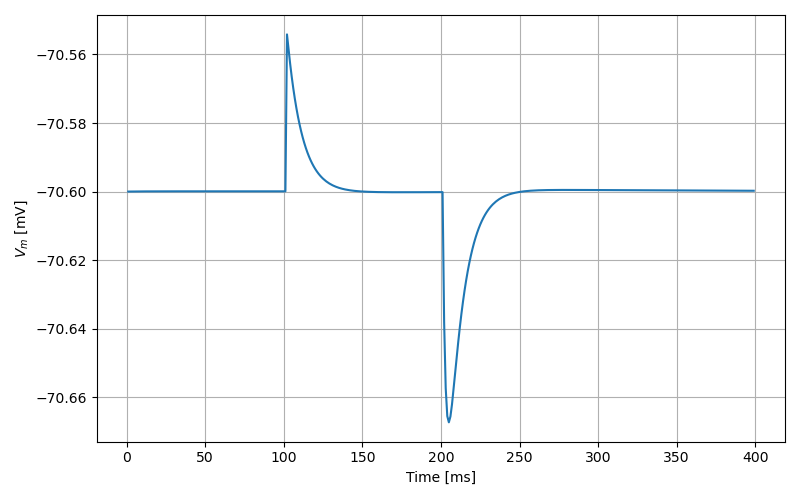
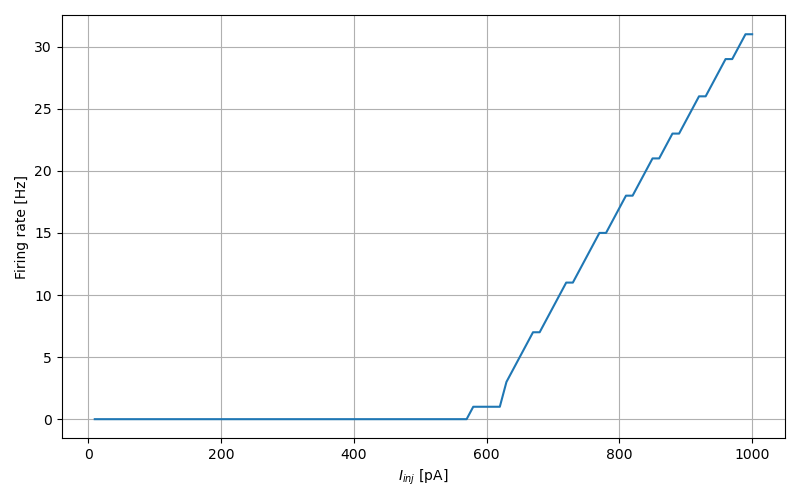
aeif_cond_exp is the adaptive exponential integrate and fire neuron according to Brette and Gerstner (2005), with post-synaptic conductances in the form of truncated exponentials.
The membrane potential is given by the following differential equation:
and
Note that the membrane potential can diverge to positive infinity due to the exponential term. To avoid numerical instabilities, instead of \(V_m\), the value \(\min(V_m,V_{peak})\) is used in the dynamical equations.
References
- 1
Brette R and Gerstner W (2005). Adaptive exponential integrate-and-fire model as an effective description of neuronal activity. Journal of Neurophysiology. 943637-3642 DOI: https://doi.org/10.1152/jn.00686.2005
See also
iaf_cond_exp, aeif_cond_alpha
Parameters
Name |
Physical unit |
Default value |
Description |
|---|---|---|---|
C_m |
pF |
281.0pF |
membrane parametersMembrane Capacitance |
t_ref |
ms |
0.0ms |
Refractory period |
V_reset |
mV |
-60.0mV |
Reset Potential |
g_L |
nS |
30.0nS |
Leak Conductance |
E_L |
mV |
-70.6mV |
Leak reversal Potential (aka resting potential) |
a |
nS |
4nS |
spike adaptation parametersSubthreshold adaptation. |
b |
pA |
80.5pA |
Spike-trigg_exred adaptation. |
Delta_T |
mV |
2.0mV |
Slope factor |
tau_w |
ms |
144.0ms |
Adaptation time constant |
V_th |
mV |
-50.4mV |
Threshold Potential |
V_peak |
mV |
0mV |
Spike detection threshold. |
E_ex |
mV |
0mV |
synaptic parametersExcitatory reversal Potential |
tau_syn_ex |
ms |
0.2ms |
Synaptic Time Constant Excitatory Synapse |
E_in |
mV |
-85.0mV |
Inhibitory reversal Potential |
tau_syn_in |
ms |
2.0ms |
Synaptic Time Constant for Inhibitory Synapse |
I_e |
pA |
0pA |
constant external input current |
State variables
Name |
Physical unit |
Default value |
Description |
|---|---|---|---|
V_m |
mV |
E_L |
Membrane potential |
w |
pA |
0pA |
Spike-adaptation current |
Equations
Source code
neuron aeif_cond_exp:

  state:
    V_m mV = E_L   # Membrane potential
    w pA = 0 pA    # Spike-adaptation current
  end

  equations:
    inline V_bounded mV = min(V_m, V_peak) # prevent exponential divergence
    kernel g_in = exp(-t / tau_syn_in)
    kernel g_ex = exp(-t / tau_syn_ex)

    # Add inlines to simplify the equation definition of V_m
    inline exp_arg real = (V_bounded - V_th) / Delta_T
    inline I_spike pA = g_L * Delta_T * exp(exp_arg)
    inline I_syn_exc pA = convolve(g_ex, spikesExc) * (V_bounded - E_ex)
    inline I_syn_inh pA = convolve(g_in, spikesInh) * (V_bounded - E_in)

    V_m' = (-g_L * (V_bounded - E_L) + I_spike - I_syn_exc - I_syn_inh - w + I_e + I_stim) / C_m
    w' = (a * (V_bounded - E_L) - w) / tau_w
  end

  parameters:
    # membrane parameters
    C_m pF = 281.0 pF       # Membrane Capacitance
    t_ref ms = 0.0 ms       # Refractory period
    V_reset mV = -60.0 mV   # Reset Potential
    g_L nS = 30.0 nS        # Leak Conductance
    E_L mV = -70.6 mV       # Leak reversal Potential (aka resting potential)

    # spike adaptation parameters
    a nS = 4 nS             # Subthreshold adaptation
    b pA = 80.5 pA          # Spike-triggered adaptation
    Delta_T mV = 2.0 mV     # Slope factor
    tau_w ms = 144.0 ms     # Adaptation time constant
    V_th mV = -50.4 mV      # Threshold Potential
    V_peak mV = 0 mV        # Spike detection threshold

    # synaptic parameters
    E_ex mV = 0 mV            # Excitatory reversal Potential
    tau_syn_ex ms = 0.2 ms    # Synaptic Time Constant Excitatory Synapse
    E_in mV = -85.0 mV        # Inhibitory reversal Potential
    tau_syn_in ms = 2.0 ms    # Synaptic Time Constant for Inhibitory Synapse

    # constant external input current
    I_e pA = 0 pA
  end

  internals:
    # refractory time in steps
    RefractoryCounts integer = steps(t_ref)
    # counts number of tick during the refractory period
    r integer
  end

  input:
    spikesInh nS <- inhibitory spike
    spikesExc nS <- excitatory spike
    I_stim pA <- continuous
  end

  output: spike

  update:
    integrate_odes()

    if r > 0: # refractory
      r -= 1 # decrement refractory ticks count
      V_m = V_reset # clamp potential
    elif V_m >= V_peak: # threshold crossing detection
      r = RefractoryCounts + 1
      V_m = V_reset # clamp potential
      w += b
      emit_spike()
    end

  end

end