iaf_cond_beta
iaf_cond_beta - Simple conductance based leaky integrate-and-fire neuron model
Description
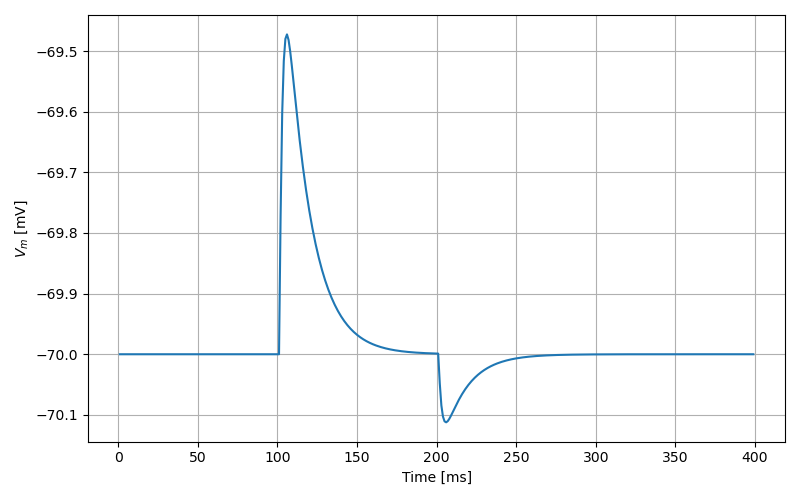
iaf_cond_beta is an implementation of a spiking neuron using IAF dynamics with conductance-based synapses. Incoming spike events induce a post-synaptic change of conductance modelled by a beta function. The beta function is normalised such that an event of weight 1.0 results in a peak current of 1 nS at \(t = \tau_{rise\_[ex|in]}\).
References
- 1
Meffin H, Burkitt AN, Grayden DB (2004). An analytical model for the large, fluctuating synaptic conductance state typical of neocortical neurons in vivo. Journal of Computational Neuroscience, 16:159-175. DOI: https://doi.org/10.1023/B:JCNS.0000014108.03012.81
- 2
Bernander O, Douglas RJ, Martin KAC, Koch C (1991). Synaptic background activity influences spatiotemporal integration in single pyramidal cells. Proceedings of the National Academy of Science USA, 88(24):11569-11573. DOI: https://doi.org/10.1073/pnas.88.24.11569
- 3
Kuhn A, Rotter S (2004) Neuronal integration of synaptic input in the fluctuation- driven regime. Journal of Neuroscience, 24(10):2345-2356 DOI: https://doi.org/10.1523/JNEUROSCI.3349-03.2004
- 4
Rotter S, Diesmann M (1999). Exact simulation of time-invariant linear systems with applications to neuronal modeling. Biologial Cybernetics 81:381-402. DOI: https://doi.org/10.1007/s004220050570
- 5
Roth A and van Rossum M (2010). Chapter 6: Modeling synapses. in De Schutter, Computational Modeling Methods for Neuroscientists, MIT Press.
See also
iaf_cond_exp, iaf_cond_alpha
Parameters
Name |
Physical unit |
Default value |
Description |
|---|---|---|---|
E_L |
mV |
-85.0mV |
Leak reversal Potential (aka resting potential) |
C_m |
pF |
250.0pF |
Capacity of the membrane |
t_ref |
ms |
2.0ms |
Refractory period |
V_th |
mV |
-55.0mV |
Threshold Potential |
V_reset |
mV |
-60.0mV |
Reset Potential |
E_ex |
mV |
0mV |
Excitatory reversal Potential |
E_in |
mV |
-85.0mV |
Inhibitory reversal Potential |
g_L |
nS |
16.6667nS |
Leak Conductance |
tau_syn_rise_I |
ms |
0.2ms |
Synaptic Time Constant Excitatory Synapse |
tau_syn_decay_I |
ms |
2.0ms |
Synaptic Time Constant for Inhibitory Synapse |
tau_syn_rise_E |
ms |
0.2ms |
Synaptic Time Constant Excitatory Synapse |
tau_syn_decay_E |
ms |
2.0ms |
Synaptic Time Constant for Inhibitory Synapse |
F_E |
nS |
0nS |
Constant External input conductance (excitatory). |
F_I |
nS |
0nS |
Constant External input conductance (inhibitory). |
I_e |
pA |
0pA |
constant external input current |
State variables
Name |
Physical unit |
Default value |
Description |
|---|---|---|---|
V_m |
mV |
E_L |
membrane potential |
g_in |
nS |
0nS |
inputs from the inh conductance |
g_in__d |
nS / ms |
0nS / ms |
inputs from the inh conductance |
g_ex |
nS |
0nS |
inputs from the exc conductance |
g_ex__d |
nS / ms |
0nS / ms |
inputs from the exc conductance |
Equations
Source code
neuron iaf_cond_beta:
   state:
     r integer = 0             # counts number of tick during the refractory period

     V_m mV = E_L              # membrane potential

     # inputs from the inhibitory conductance
     g_in real = 0
     g_in$ real = g_I_const * (1 / tau_syn_rise_I - 1 / tau_syn_decay_I)

     # inputs from the excitatory conductance
     g_ex real = 0
     g_ex$ real = g_E_const * (1 / tau_syn_rise_E - 1 / tau_syn_decay_E)
   end

   equations:
       kernel g_in' = g_in$ - g_in / tau_syn_rise_I,
              g_in$' = -g_in$ / tau_syn_decay_I

       kernel g_ex' = g_ex$ - g_ex / tau_syn_rise_E,
              g_ex$' = -g_ex$ / tau_syn_decay_E

       inline I_syn_exc pA = (F_E + convolve(g_ex, spikeExc)) * (V_m - E_ex)
       inline I_syn_inh pA = (F_I + convolve(g_in, spikeInh)) * (V_m - E_in)
       inline I_leak pA = g_L * (V_m - E_L)  # pA = nS * mV
       V_m' =  (-I_leak - I_syn_exc - I_syn_inh + I_e + I_stim ) / C_m
   end

   parameters:
     E_L mV = -70. mV              # Leak reversal potential (aka resting potential)
     C_m pF = 250. pF              # Capacitance of the membrane
     t_ref ms = 2. ms              # Refractory period
     V_th mV = -55. mV             # Threshold potential
     V_reset mV = -60. mV          # Reset potential
     E_ex mV = 0 mV                # Excitatory reversal potential
     E_in mV = -85. mV             # Inhibitory reversal potential
     g_L nS = 16.6667 nS           # Leak conductance
     tau_syn_rise_I ms = .2 ms     # Synaptic time constant excitatory synapse
     tau_syn_decay_I ms = 2. ms    # Synaptic time constant for inhibitory synapse
     tau_syn_rise_E ms = .2 ms     # Synaptic time constant excitatory synapse
     tau_syn_decay_E ms = 2. ms    # Synaptic time constant for inhibitory synapse
     F_E nS = 0 nS                 # Constant external input conductance (excitatory).
     F_I nS = 0 nS                 # Constant external input conductance (inhibitory).

     # constant external input current
     I_e pA = 0 pA
   end

   internals:
     # time of peak conductance excursion after spike arrival at t = 0
     t_peak_E real = tau_syn_decay_E * tau_syn_rise_E * ln(tau_syn_decay_E / tau_syn_rise_E) / (tau_syn_decay_E - tau_syn_rise_E)
     t_peak_I real = tau_syn_decay_I * tau_syn_rise_I * ln(tau_syn_decay_I / tau_syn_rise_I) / (tau_syn_decay_I - tau_syn_rise_I)

     # normalisation constants to ensure arriving spike yields peak conductance of 1 nS
     g_E_const real = 1 / (exp(-t_peak_E / tau_syn_decay_E) - exp(-t_peak_E / tau_syn_rise_E))
     g_I_const real = 1 / (exp(-t_peak_I / tau_syn_decay_I) - exp(-t_peak_I / tau_syn_rise_I))

     RefractoryCounts integer = steps(t_ref) # refractory time in steps
   end

   input:
     spikeInh nS <- inhibitory spike
     spikeExc nS <- excitatory spike
     I_stim pA <- continuous
   end

   output: spike

   update:
     integrate_odes()
     if r != 0: # not refractory
       r =  r - 1
       V_m = V_reset # clamp potential
     elif V_m >= V_th:
       r = RefractoryCounts
       V_m = V_reset # clamp potential
       emit_spike()
     end
   end

 end